Visible arcing inside a microwave may be caused by metal, damaged accessories, food residue, a damaged waveguide-cover area, or an internal electrical/high-voltage problem. Continuing to run it can worsen damage.
If a microwave arcs or sparks, stop it immediately and keep it off until the cause is found. Metal in the cavity, damaged accessories, food residue or a damaged waveguide cover can all cause it, and so can a fault inside the cabinet. Remove only obvious metal after the cavity has cooled, and book diagnosis if arcing returns.
Visible arcing inside a microwave may be caused by metal, damaged accessories, food residue, a damaged waveguide-cover area, or an internal electrical/high-voltage problem. Continuing to run it can worsen damage.
Microwave energy drives electrical current in metal, so sharp edges, thin foil and gold-rimmed dishes can spark. Burnt food residue in the cavity can carbonize and spark as well, which is why wiping the cavity matters.
Arcing in an empty cavity, or with no obvious metal, is a different matter from sparking caused by a fork left in a bowl. The first deserves a technician and the second may be resolved by removing the metal.
Microwave troubleshooting must stay external. The display, fan, light, turntable, door, and normal user controls can provide clues, but the outer cabinet should not be removed by a homeowner.
High-voltage microwave components can remain hazardous even after power is disconnected.
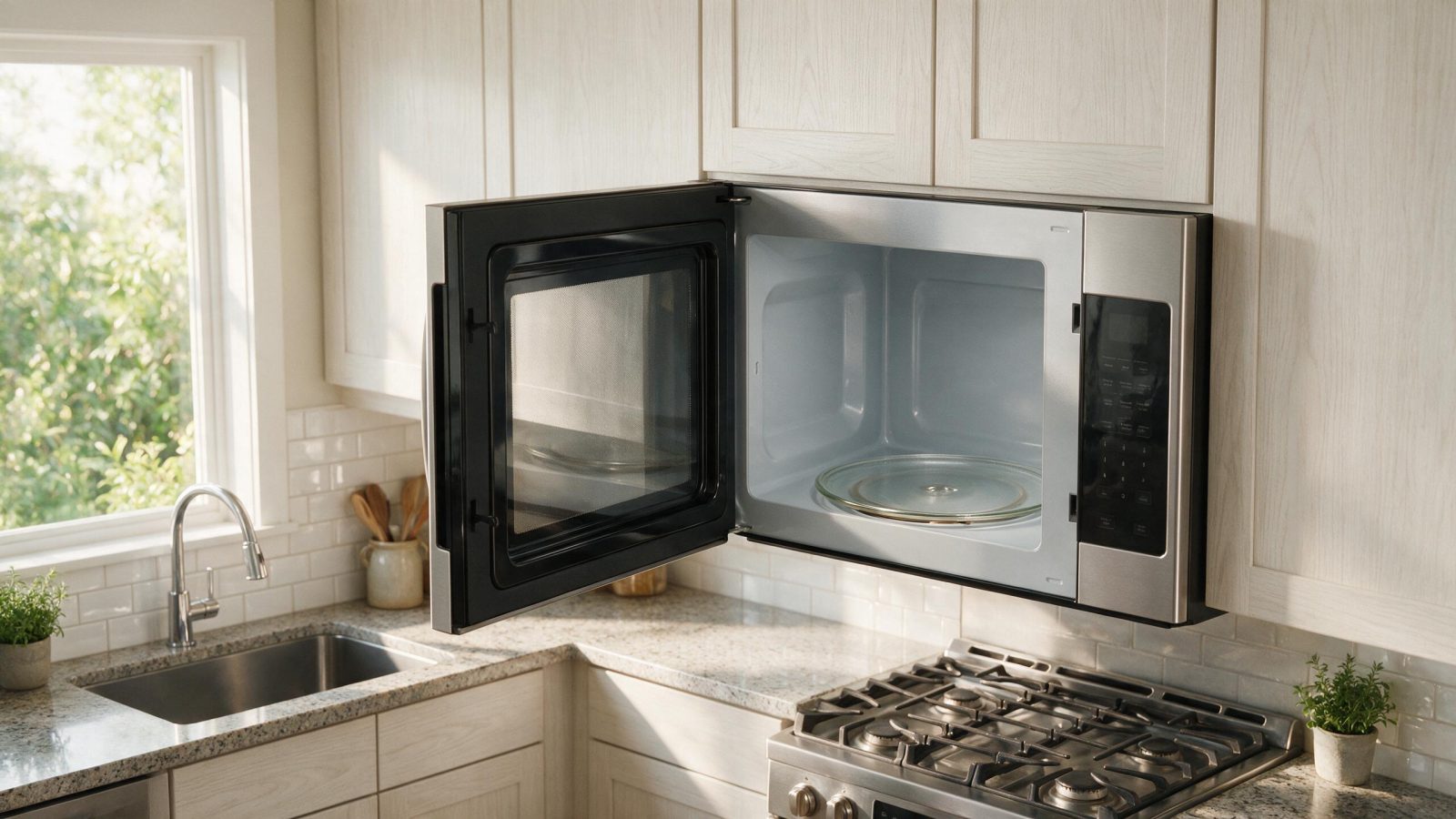
Frigidaire’s guidance says to clean the waveguide cover, the metal-looking plate on the sidewall, gently with a damp cloth and never to remove it. The turntable and support lift out for washing. Some microwaves have a metal turntable, and popcorn bags should go on a popcorn or bacon plate there, because the bag’s metal can interfere with it.
| Symptom | What it can point to | What you can check |
|---|---|---|
| Sparks with a metal item inside | Metal in the cavity | Stop, let it cool, remove the metal and rerun with a plain dish |
| Sparks at the sidewall plate | Food residue on or damage to the waveguide cover | Look at the cover and wipe gently with a damp cloth; do not remove it |
| Arcing in an empty or clean cavity | A fault inside the microwave | Stop using it and book diagnosis |
| Burning smell with sparking | Overheating or damage | Unplug if safe and leave it off |
Do not remove the microwave cabinet. High-voltage components can remain hazardous even after the appliance is unplugged.
Stop normal operation when there is smoke, sparking, burning electrical odor, repeated breaker trips, persistent gas odor, uncontrolled overheating, or water contacting electrical connections.
A microwave that sparked may still show a normal display, a working light, a spinning turntable and a running fan. Those only prove the controls and low-power parts are alive. They say nothing about whether the cavity or waveguide cover is damaged, so do not read normal-looking behavior as permission to keep running it.
When you call for service, describe what was inside, where the sparks appeared and whether the cavity shows scorch marks or peeling paint. Do not run it empty to reproduce the problem, since that can damage it further.
Do not bypass safety devices or open internal electrical, gas, sealed-refrigeration, or microwave high-voltage areas.
Send:
– the complete Frigidaire model number;
– the exact symptom;
– when it began;
– whether it is constant or intermittent;
– what still works normally;
– any displayed code or status message;
– any recent power, water, gas, venting, cleaning, or installation event.
These details help the technician choose a narrow test path instead of repeating owner-level checks.
For an adjacent symptom, read Frigidaire Oven F10 or Runaway Heat: When Temperature Becomes a Stop-Use Issue and Frigidaire Gas Burner Won't Light: Safe Ignition Checks and the Gas-Odor Boundary.
Microwave symptoms can look deceptively simple because the display, light, fan, and turntable may still work even when the heating system is not normal. Keep observations limited to normal user controls and the cavity.
If arcing occurred, note what was inside the oven and whether the cavity has visible residue or damage. If the microwave runs but does not heat, do not open the cabinet to inspect a fuse, capacitor, magnetron, transformer, or inverter. High-voltage components require trained service and can remain hazardous after unplugging.
Do not clear a code before recording it, do not order a part only because another Frigidaire owner reported the same symptom, and do not create a new problem by moving a built-in appliance without a service plan. The exact model number is the bridge between the symptom and the correct technical information.
One controlled owner-level check is useful when it answers a question. Repeating resets, changing several settings at once, or disassembling the appliance usually removes evidence rather than adding it.
Use one normal manual-approved restart when appropriate. If the same symptom returns, repeated resets are not a repair and can erase useful evidence.
Usually not. Similar symptoms can come from different components, installation conditions, or external utilities.
No. Keep homeowner checks external and model-appropriate.
If a clear cause such as metal was found and the cavity is clean, a short test with a microwave-safe dish may be reasonable. If it sparks again or the cause is unclear, stop using it.
Frigidaire’s guidance says to wipe it gently with a damp cloth and never remove it.
On models with a metal turntable, the bag’s metal can interfere. Frigidaire advises using the popcorn or bacon plate there.
Use one normal manual-approved restart when appropriate. If the same symptom returns, repeated resets are not a repair and can erase useful evidence.
Usually not. Similar symptoms can come from different components, installation conditions, or external utilities.
No. Keep homeowner checks external and model-appropriate.
A refrigerator that cannot maintain safe temperature creates a food-storage decision before it creates a repair decision. The first step is to measure temperature…
A hot-lint smell after a neglected filter is different from a sharp electrical odor, melting-plastic smell, smoke, or repeated overheating. A dryer should not…
A washer leak can begin at a hose, dispenser, door/gasket, pump area, or drain path. The safety concern rises when water spreads toward an…
Share a few details and we’ll confirm an appointment. Prefer to talk? Call us and we’ll help right away.
Fields marked with * are required.