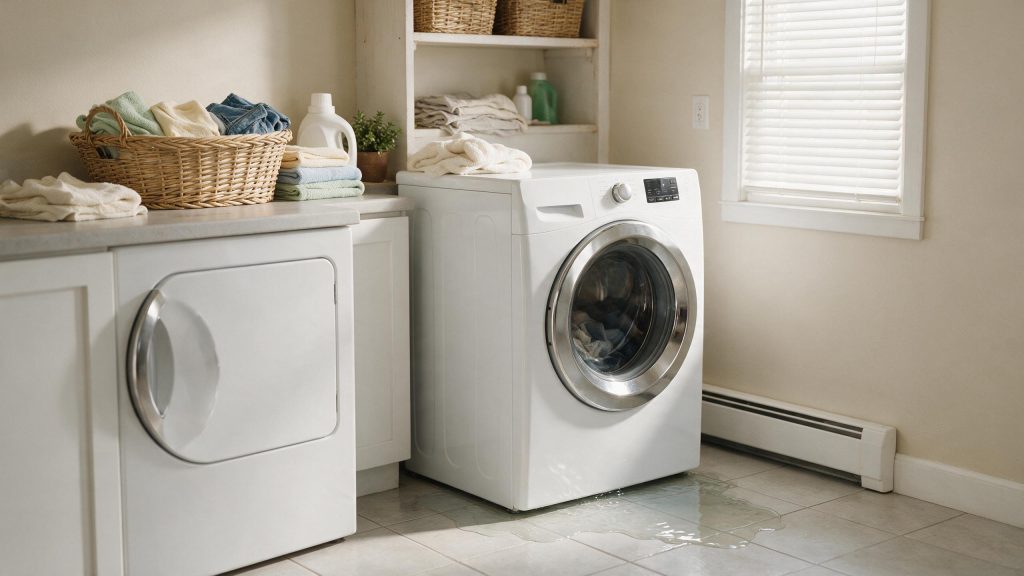
A washer leak can begin at a hose, dispenser, door/gasket, pump area, or drain path. The safety concern rises when water spreads toward an outlet, plug, power strip, or exposed electrical connection.
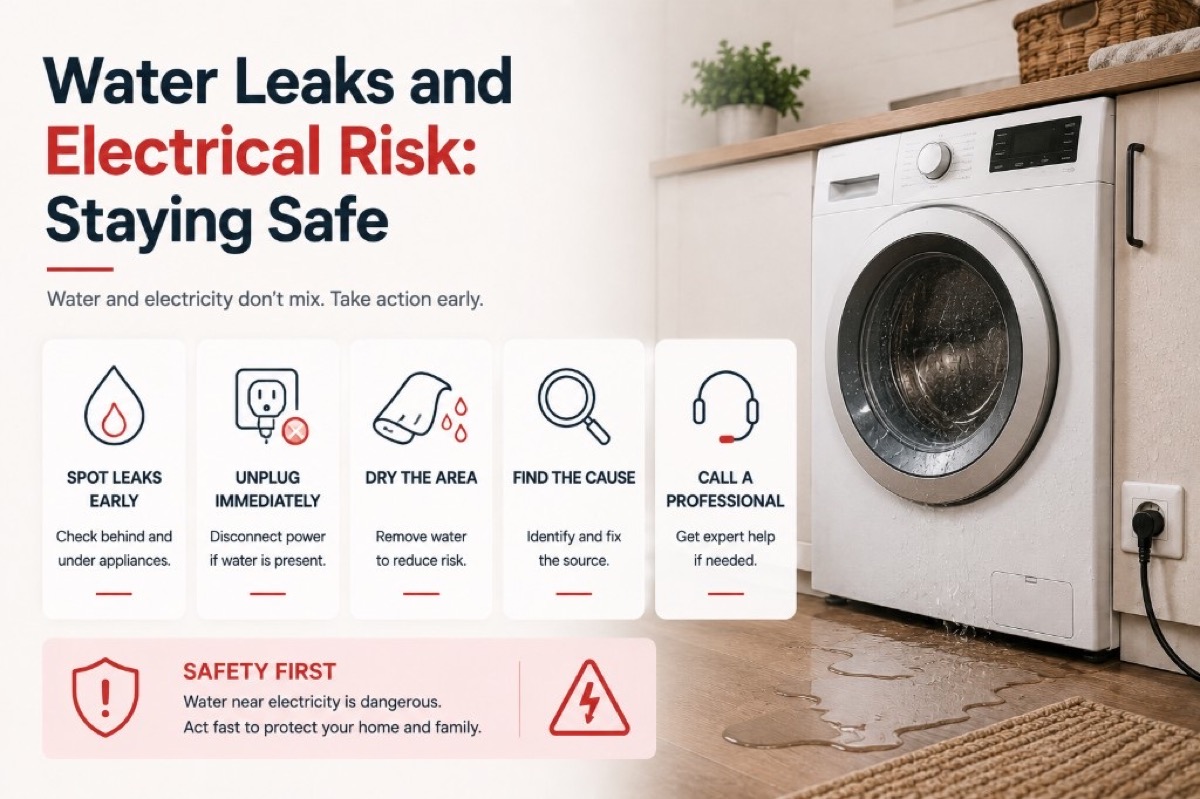
Water around a washer is a leak-source question and an electrical-safety question at once. Stop the cycle, shut off the supply if you can do so safely, and keep clear of outlets and plugs if water has reached them. Then identify where the water starts: a hose, the dispenser, the door seal, or the drain path.
A washer leak can begin at a hose, dispenser, door/gasket, pump area, or drain path. The safety concern rises when water spreads toward an outlet, plug, power strip, or exposed electrical connection.
Frigidaire’s leak checklist lists a clogged drain, a hose out of the standpipe, loose or cross-threaded fill hoses with worn rubber washers, and suds overflow from non-HE detergent, too much detergent or soft water. That list is a good way to sort water that appears during fill, wash or drain.
For laundry symptoms, note whether the washer fills, tumbles/agitate, drains, and attempts to spin. A machine that will not spin because water is still inside has a different diagnostic path from one that drains completely and still cannot spin.
Avoid overloading and excessive detergent during troubleshooting because both can hide the original pattern.
| Symptom | What it can point to | What you can check |
|---|---|---|
| Water at the faucet end during fill | A loose fill hose or worn washer | Check the visible connection is tight |
| Water when draining | Hose out of the standpipe or a drain clog | Check the hose position and routing |
| Suds spilling out | Too much or the wrong detergent | Use HE detergent and run an empty Quick Wash |
| Water near the outlet or plug | Electrical risk | Keep clear and switch off at the breaker if safe |
If water has reached electrical components or an outlet area, do not restart the washer until the leak source and electrical safety have been addressed.
Frigidaire’s guidance says the drain standpipe should be at least 1-1/4 inches in diameter and no higher than 96 inches, and the hose should not be sealed fully into the standpipe because it needs air. Too much detergent can slow draining and cause overflow, so use HE detergent and stay under the maximum fill line.
Stop normal operation when there is smoke, sparking, burning electrical odor, repeated breaker trips, persistent gas odor, uncontrolled overheating, or water contacting electrical connections.
Water that shows up during fill points toward the supply side, such as hoses and faucet connections. Water that appears during wash can be a door seal, dispenser or suds overflow, and water during drain suggests the drain hose, standpipe or a clog. Noticing which stage it happens in does more to narrow the source than mopping up and running another cycle.
After an electrical safety concern, a dry floor and a washer that looks normal still do not prove it is safe, so do not restart it until the source is known.
Do not bypass safety devices or open internal electrical, gas, sealed-refrigeration, or microwave high-voltage areas.
Send:
– the complete Frigidaire model number;
– the exact symptom;
– when it began;
– whether it is constant or intermittent;
– what still works normally;
– any displayed code or status message;
– any recent power, water, gas, venting, cleaning, or installation event.
These details help the technician choose a narrow test path instead of repeating owner-level checks.
For an adjacent symptom, read Frigidaire Washer Won't Spin: Balance, Drainage, and Door Lock Before Motor Guessing and Frigidaire Washer Drain Repair Cost: Filter, Hose, Pump, or Control?.
Laundry diagnosis improves when you separate the four basic actions: fill, wash/tumble, drain, and spin. Note exactly where the Frigidaire washer stops. A washer that cannot drain may intentionally refuse high-speed spin, while a washer that drains completely but never spins points elsewhere.
Also record load type and detergent use. A single heavy blanket, oversudsing, or a door/lid condition can create a misleading one-cycle problem. If the issue repeats with a normal balanced load, that repeatability is more useful than trying several unrelated cycles.
Do not clear a code before recording it, do not order a part only because another Frigidaire owner reported the same symptom, and do not create a new problem by moving a built-in appliance without a service plan. The exact model number is the bridge between the symptom and the correct technical information.
One controlled owner-level check is useful when it answers a question. Repeating resets, changing several settings at once, or disassembling the appliance usually removes evidence rather than adding it.
Use one normal manual-approved restart when appropriate. If the same symptom returns, repeated resets are not a repair and can erase useful evidence.
Usually not. Similar symptoms can come from different components, installation conditions, or external utilities.
No. Keep homeowner checks external and model-appropriate.
Not until the source is found and water is away from outlets and connections. If water reached an electrical area, leave the washer off until it has been checked.
Yes. Frigidaire lists suds overflow from too much detergent or non-HE detergent among leak causes.
If it can be done safely and water keeps escaping, yes. Turn it off at the household valve.
Use one normal manual-approved restart when appropriate. If the same symptom returns, repeated resets are not a repair and can erase useful evidence.
Usually not. Similar symptoms can come from different components, installation conditions, or external utilities.
No. Keep homeowner checks external and model-appropriate.
A refrigerator that cannot maintain safe temperature creates a food-storage decision before it creates a repair decision. The first step is to measure temperature…
A hot-lint smell after a neglected filter is different from a sharp electrical odor, melting-plastic smell, smoke, or repeated overheating. A dryer should not…
Visible arcing inside a microwave may be caused by metal, damaged accessories, food residue, a damaged waveguide-cover area, or an internal electrical/high-voltage problem. Continuing…
Share a few details and we’ll confirm an appointment. Prefer to talk? Call us and we’ll help right away.
Fields marked with * are required.