Frost grows when humid room air repeatedly enters the cabinet or moisture cannot move through the normal defrost/airflow path. Good door and loading habits can reduce avoidable frost without hacking ice away.
Avoidable freezer frost traces back to humid air getting in or cold air not circulating. The routine is simple: make sure the door closes fully, keep the gasket clean, and do not pack food against the vents. Set the freezer near the recommended temperature rather than colder. If frost keeps returning in the same place after that, it needs diagnosis, not scraping.
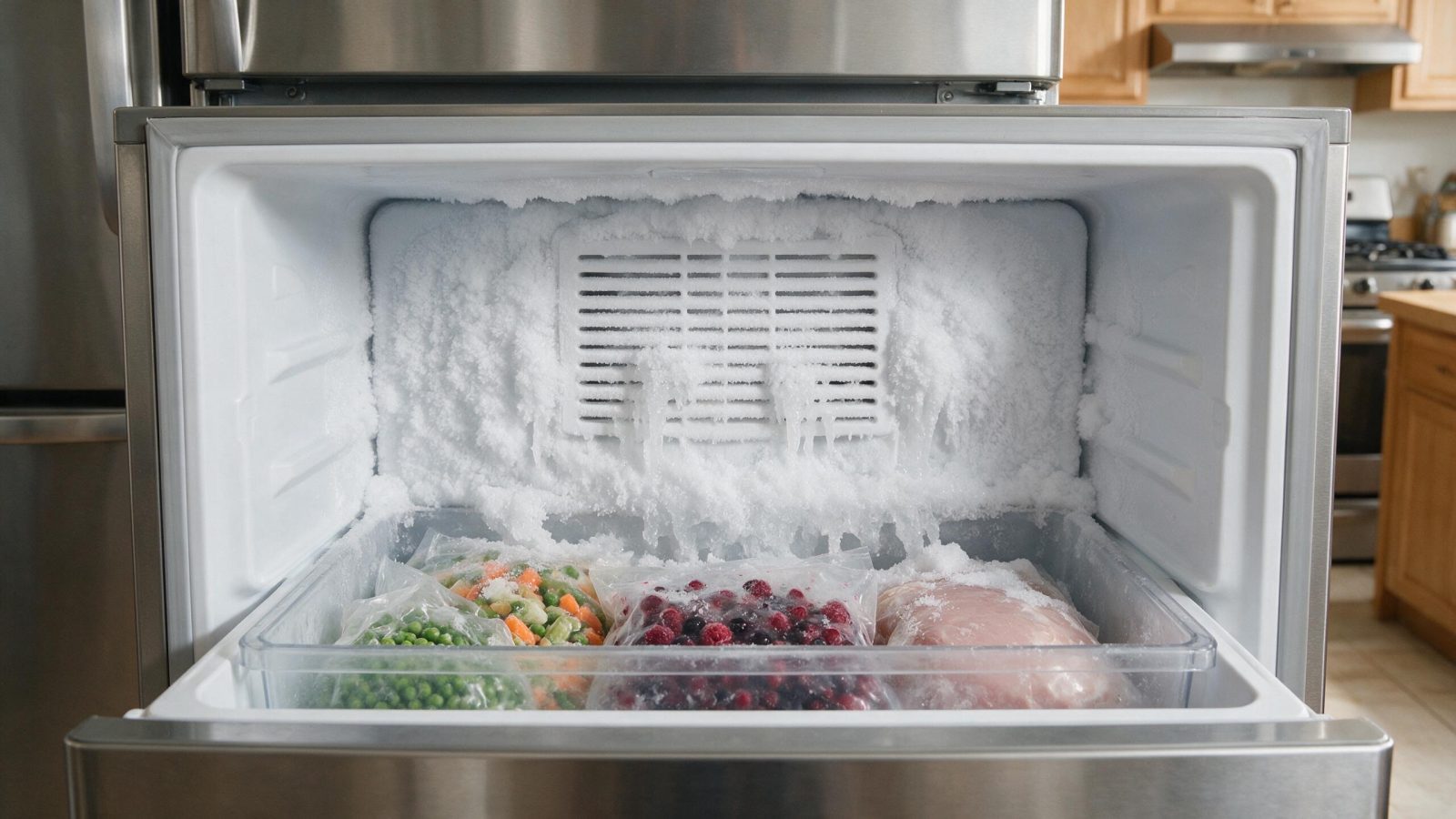
Frost grows when humid room air repeatedly enters the cabinet or moisture cannot move through the normal defrost/airflow path. Good door and loading habits can reduce avoidable frost without hacking ice away.
Freezer symptoms are easiest to judge with measured temperature and a frost map. Note whether frost is concentrated around a door opening, one wall, or the evaporator area rather than chipping everything away before the pattern is documented.
Frigidaire’s guidance explains that frost forms when warm and cold air mix below freezing. The causes it lists include a warped door or worn gasket, an ice chute flap that does not close, a temperature set below 0 degrees F, and poor airflow from blocked vents or the way items are placed. Each one lets humid air in or keeps cold air from moving, which is why the pattern of the frost is a useful clue.
Food protection comes before diagnosis if the cabinet is warming.
Maintenance should preserve normal airflow, water flow, sealing, loading, cleanliness, and utility conditions. It should not turn into disassembly.
| Symptom | What it can point to | What you can check |
|---|---|---|
| Frost along the door edge | Air leaking past the gasket or a door not closing fully | Check for packages or ice blocking the door and clean the gasket |
| Frost near the ice chute | A flap that is not closing | Look for stuck ice or debris near the flap |
| Broad frost across the interior | Airflow, loading or a very cold setting | Move items away from vents and confirm the setting |
| Frost along with warming food | Cooling is failing | Protect food first, then arrange diagnosis |
If frost returns rapidly in the same area, or cooling worsens, the problem may involve sealing, defrost, sensing, airflow, or controls and needs diagnosis.
Frigidaire’s guidance describes a simple seal test: close the door on a dollar bill and tug it. Some resistance means the seal is holding, while a bill that slides out freely suggests a weak seal. Clean the gasket with warm soapy water first, because residue alone can break the seal.
The recommended freezer setting is 0 degrees F, with an acceptable range of about minus 6 to 6. A colder setting is listed among the frost causes, so lowering it further is more likely to add frost than remove it. After a power loss or change, allow the cabinet time to stabilize before judging.
If the symptom returns after correct routine care, move to diagnosis rather than stronger chemicals, more frequent resets, or random part replacement.
Send:
– the complete Frigidaire model number;
– the exact symptom;
– when it began;
– whether it is constant or intermittent;
– what still works normally;
– any displayed code or status message;
– any recent power, water, gas, venting, cleaning, or installation event.
These details help the technician choose a narrow test path instead of repeating owner-level checks.
For an adjacent symptom, read Frigidaire Refrigerator Warm but Freezer Cold: Follow the Airflow Clues and Frigidaire Ice Maker Not Making Ice: Temperature, Water, and Time Come First.
Freezer problems should be documented before frost is removed. Take a photo of where ice is concentrated and measure the temperature. Frost around a door edge suggests a different path from a broad internal frost pattern or a cabinet that simply warms without frost.
Protect food first if temperature is rising. Do not chip ice with knives or heat the liner aggressively. After normal door/seal/loading checks, rapidly returning frost or poor temperature control needs diagnosis of sealing, airflow, defrost, sensing, or refrigeration systems.
Do not clear a code before recording it, do not order a part only because another Frigidaire owner reported the same symptom, and do not create a new problem by moving a built-in appliance without a service plan. The exact model number is the bridge between the symptom and the correct technical information.
One controlled owner-level check is useful when it answers a question. Repeating resets, changing several settings at once, or disassembling the appliance usually removes evidence rather than adding it.
Use one normal manual-approved restart when appropriate. If the same symptom returns, repeated resets are not a repair and can erase useful evidence.
Usually not. Similar symptoms can come from different components, installation conditions, or external utilities.
No. Keep homeowner checks external and model-appropriate.
It is better not to use knives or sharp tools on the liner. Document the pattern first, then let the frost clear naturally if food is protected. Fast regrowth in the same spot points to a diagnosis.
Frigidaire’s guidance recommends 0 degrees F, with about minus 6 to 6 considered acceptable. Check your manual for your model.
A flap that does not close fully is one cause Frigidaire lists. Check for ice or debris holding it open, and mention the location if the frost keeps coming back.
Use one normal manual-approved restart when appropriate. If the same symptom returns, repeated resets are not a repair and can erase useful evidence.
Usually not. Similar symptoms can come from different components, installation conditions, or external utilities.
No. Keep homeowner checks external and model-appropriate.
Spills and cleaning moisture can make a gas burner harder to light even when the ignition system is healthy. Correct cap placement and complete…
A dryer depends on moving heated moist air out of the home. A clean lint filter is only one part of the airflow path;…
Poor washing and slow draining often become more noticeable when food debris builds in the user-accessible filter or glass-trap area. Routine cleaning gives the…
Share a few details and we’ll confirm an appointment. Prefer to talk? Call us and we’ll help right away.
Fields marked with * are required.