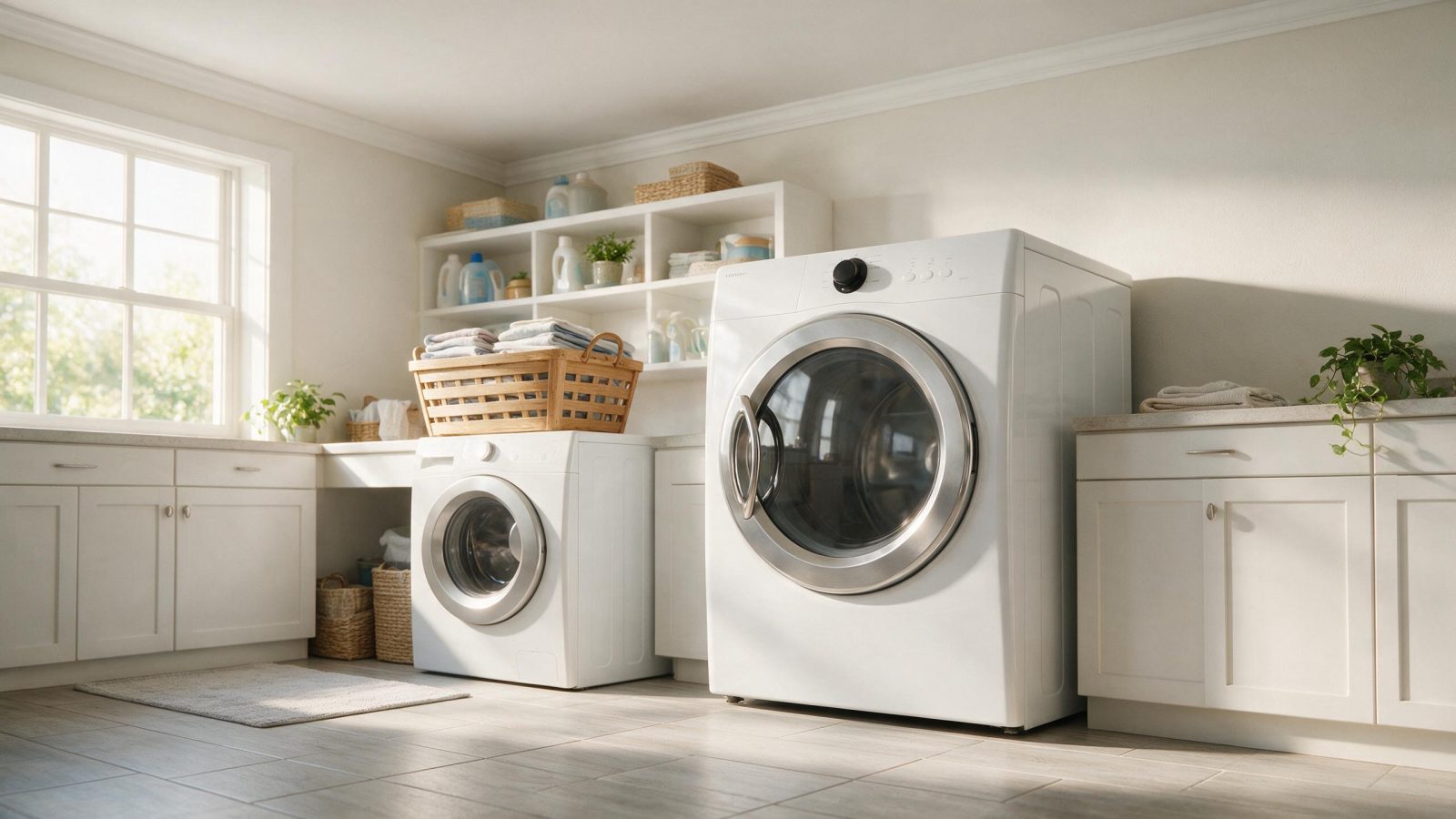
A dryer that starts and then stops can be reacting to overheating, restricted airflow, door-switch interruption, motor protection, sensor/control behavior, or power conditions. The time before it stops is useful…
A dryer that quits partway through a cycle is often protecting itself. Heat that cannot escape through a restricted vent, an overloaded drum, or a door that is not registering as closed can each stop it. Clean the lint screen, reduce the load, check the vent, and see whether the dryer runs again after cooling. If it keeps stopping after those checks, book diagnosis rather than restarting it repeatedly.
A dryer that starts and then stops can be reacting to overheating, restricted airflow, door-switch interruption, motor protection, sensor/control behavior, or power conditions. The time before it stops is useful evidence.
Clean the lint filter and confirm accessible venting is not crushed. Frigidaire’s dryer guidance calls for cleaning the lint screen every load and cleaning the outdoor exhaust and whole vent system about every 18 months.
Note whether the dryer is unusually hot when it stops.
Frigidaire’s support guidance says an overloaded dryer can overheat its motor. Its suggestion is to let the dryer cool for 30 minutes and then keep loads to roughly one-third to one-half of the drum. A single bulky item, such as a comforter, can behave like an overload even when the weight seems modest.
On electric dryers a tripped thermal limiter switch shuts the motor off, and that part has to be replaced by a service provider rather than reset by the owner. So a dryer that stays dead after a full cool-down, even with a light load and a clear vent, deserves a booking rather than more restarts.
Check whether it restarts only after cooling and whether the display remains powered.
Dryer diagnosis should separate heat from airflow. Dryers need both. A restricted vent can create long drying, overheating, shutdowns, and safety-device operation even when the heater or burner is functioning.
| What you notice | What it can point to | What you can safely check |
|---|---|---|
| Stops when hot, restarts after cooling | Restricted airflow or overheating protection | Clean the lint screen, look at the visible duct, and use a smaller load |
| Stops with a very full drum | Overload straining the motor | Let it cool, then run a smaller load |
| Stops when the door or load shifts | A door that is not seen as closed | Close the door firmly and keep clothing out of the door opening |
| Stops and the display goes dark | A power supply issue | Check that the plug is firm, no extension cord is used, and the breaker or fuse has not tripped |
| Stops only on heated cycles | Heat and airflow interacting | Compare with a no-heat setting if the model has one, and look at vent flow outside |
Do not run repeated test loads through a dryer that smells electrically hot or shows smoke, sparking, or severe overheating.
A repeatable heat-related shutdown deserves airflow and internal heating/motor diagnosis rather than repeated restart attempts.
Timing is evidence. A dryer that stops at roughly the same point in every heated cycle behaves differently from one that stops at random, and a drum that is scorching hot when you open it tells a different story from one that is only warm. Whether it restarts on its own after a rest matters as well.
Outside, look at the hood. Frigidaire’s guidance describes an approved hood with a swing-out damper, no screen over the opening, and at least 12 inches between the bottom of the hood and the ground. A flap that barely lifts during a cycle points back toward airflow.
Record the complete model number and any displayed code before resetting power. Frigidaire code meanings must be interpreted in appliance/model context rather than treated as universal.
Send:
– the complete Frigidaire model number;
– the exact symptom;
– when it began;
– whether it is constant or intermittent;
– what still works normally;
– any displayed code or status message;
– any recent power, water, gas, venting, cleaning, or installation event.
These details help the technician choose a narrow test path instead of repeating owner-level checks.
For an adjacent symptom, read Frigidaire Dryer Takes Too Long: Airflow Is the First System to Prove and Frigidaire Dryer Runs but Has No Heat: What Changes the Repair Cost.
Dryer symptoms should be judged with both heat and airflow in mind. A vent restriction can lengthen drying time, trigger high-limit protection, and make the cabinet unusually hot while the heating element or gas burner is still working. Conversely, strong airflow with no heat points in a different direction.
Note whether the dryer stops only on heated cycles, whether it restarts after cooling, and whether the exterior vent has strong flow. Do not use repeated high-heat test loads when the appliance smells hot or shuts down protectively.
Do not clear a code before recording it, do not order a part only because another Frigidaire owner reported the same symptom, and do not create a new problem by moving a built-in appliance without a service plan. The exact model number is the bridge between the symptom and the correct technical information.
One controlled owner-level check is useful when it answers a question. Repeating resets, changing several settings at once, or disassembling the appliance usually removes evidence rather than adding it.
Use one normal manual-approved restart when appropriate. If the same symptom returns, repeated resets are not a repair and can erase useful evidence.
Usually not. Similar symptoms can come from different components, installation conditions, or external utilities.
No. Keep homeowner checks external and model-appropriate.
Frigidaire’s guidance for an overheated motor is to let the dryer cool for 30 minutes, then run a smaller load. Check your own manual for the exact wording for your model.
Yes. Trapped heat can cause overheating protection to stop the dryer, even when the heater itself is working. That is why the lint screen and vent come before any part guess.
One restart after cooling is reasonable. If it stops again, or you notice smoke, an electrical smell or sparks, leave it off and book diagnosis.
Use one normal manual-approved restart when appropriate. If the same symptom returns, repeated resets are not a repair and can erase useful evidence.
Usually not. Similar symptoms can come from different components, installation conditions, or external utilities.
No. Keep homeowner checks external and model-appropriate.
Induction zones need compatible magnetic cookware of an appropriate size and position. A pan problem can look exactly like a dead cooking zone until…
A washer can appear dead because of control lock, delayed start, a door/lid that is not recognized, supply power, or an internal control/lock problem.…
A dishwasher cannot wash if it never receives the expected water. First determine whether the cycle actually starts and whether the problem is no…
Share a few details and we’ll confirm an appointment. Prefer to talk? Call us and we’ll help right away.
Fields marked with * are required.